
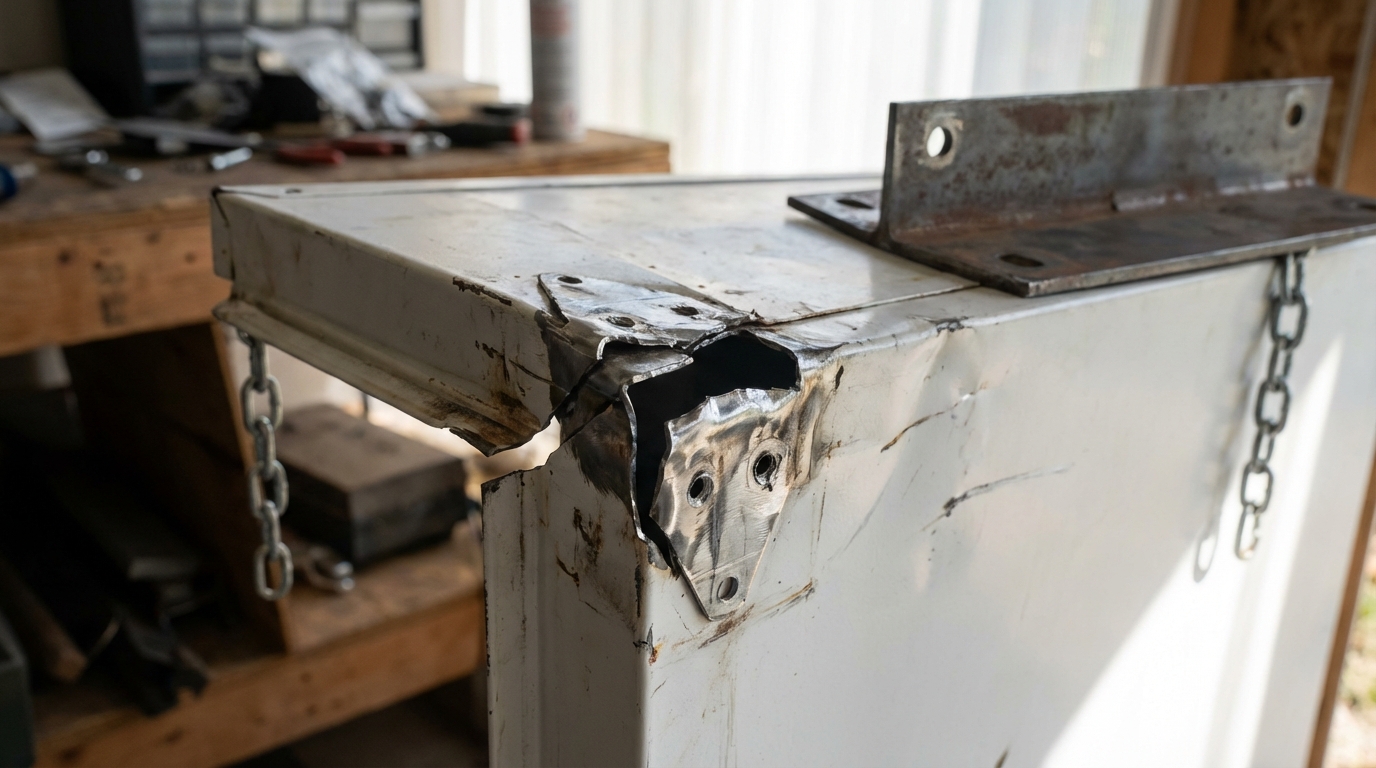
A torn opener pull bracket—often referred to as an operator bracket—is one of the most alarming garage door failures a homeowner can experience. You press the remote, hear a loud metallic tearing sound, and watch as the motor arm rips completely away from the top panel of your garage door. This failure leaves your door stuck, your opener useless, and your home unsecured. For Houston homeowners, this issue is especially prevalent due to a combination of high humidity, fluctuating temperatures, and the frequent use of heavy wind-load rated doors required in the Gulf Coast region.
Why Does the Opener Pull Bracket Tear Out?
The pull bracket is the critical connection point between your automatic garage door opener and the door itself. When it tears out, the root cause is rarely the bracket alone. Instead, it is typically a symptom of underlying mechanical stress. Understanding these causes is the first step to a permanent fix.
1. Thin Gauge Steel and Lack of Reinforcement
Many builder-grade garage doors feature thin, 24-gauge or 25-gauge steel panels. Without a structural reinforcement strut or a heavy-duty operator plate running across the top section, the constant push and pull of the motor stresses the thin sheet metal. Over time, metal fatigue sets in, causing the screws to strip and the bracket to tear through the panel.
2. Improper Opener Force Settings
Garage door openers are equipped with force adjustment settings that dictate how hard the motor pushes and pulls. If these settings are calibrated too high, the motor will continue to yank on the door even if there is mechanical resistance. This brute force transfers directly to the pull bracket, eventually ripping it from the door.
3. Failing Torsion Springs
Your garage door opener is not designed to lift the dead weight of the door. That is the job of the torsion springs. The springs act as a counterbalance system, making a 150-pound door feel like it weighs only 10 pounds. If your springs lose tension over time or break entirely, the opener is forced to drag the full weight of the door. The pull bracket is not engineered for this load and will eventually tear out.
4. Houston Humidity and Corrosion
Houston's subtropical climate introduces high moisture levels that can accelerate oxidation on garage door components. If the top panel's center stile or the bracket screws begin to rust, their structural integrity is severely compromised. A weakened, rusted connection point will inevitably fail under the daily stress of opening and closing.
Immediate Steps to Take When the Bracket Tears
If your bracket has already torn out, safety must be your immediate priority. Do not repeatedly press the remote to force the door closed, as this can severely damage the motor gears or bend the opener arm.
- Disconnect the Opener: Pull the red emergency release cord hanging from the opener rail. This detaches the carriage from the drive system, isolating the motor from the door.
- Test the Door Manually: Carefully attempt to lift the door by hand. If it feels excessively heavy or slams back down, your torsion springs are likely compromised. If it moves smoothly, the issue is isolated to the top panel and bracket.
- Secure the Door: Ensure the door is fully closed and manually lock it by sliding the interior lock or placing a C-clamp on the track just above a roller.
How to Fix a Torn Opener Bracket
Fixing a torn bracket requires more than just screwing the old piece of metal back into the door. Reusing the torn holes will result in an immediate repeat failure. The solution is to distribute the pulling force across a wider surface area using an Operator Reinforcement Bracket (ORB).
Step 1: Assess the Panel Damage
Inspect the top panel. If the tear is localized to the center stile and the horizontal structure of the panel is intact, a repair is highly effective. However, if the entire top panel is creased, buckled, or folded horizontally, the panel itself has lost its structural integrity and must be replaced.
Step 2: Procure an Adjustable Reinforcement Bracket
Purchase a heavy-duty, adjustable operator reinforcement bracket. These are typically 21-inch or 24-inch vertical steel braces that wrap around the top and bottom lips of the top garage door section. Brands like Clopay and Wayne Dalton manufacture high-quality, heavy-gauge steel brackets designed to span the entire height of the panel.
Step 3: Install the Reinforcement Bracket
Center the new reinforcement bracket over the torn section. The bracket should hook securely under the bottom lip of the top panel and extend to the top edge. To install it securely, use a combination of self-tapping sheet metal screws and through-bolts. For the strongest hold, drill completely through the door panel and use 1/4-inch carriage bolts secured with washers and nylon-insert lock nuts on the inside. The smooth, rounded heads of the carriage bolts will sit flush on the exterior of the door, maintaining a clean aesthetic while providing maximum pull-through resistance.
Step 4: Reattach the Opener Arm
Once the massive reinforcement bracket is bolted securely to the panel, you will notice it features a built-in heavy-duty clevis or attachment point. Secure the curved opener arm directly to this new bracket using a fresh clevis pin and cotter ring. Ensure the angle of the opener arm is correct; when the door is fully closed, the straight and curved arms should meet at an angle that provides smooth, downward pressure without binding.
Prevention Strategies for Houston Homeowners
Preventing bracket tear-out saves you time, money, and the stress of an unexpected garage door failure. Implement these preventative maintenance steps to protect your investment.
1. Perform Routine Balance Tests
Every six months, pull the red emergency release cord to disconnect the opener. Lift the door manually to waist height and let go. The door should remain perfectly in place, supported by the torsion springs. If it falls to the floor or shoots upward, the spring tension is dangerously incorrect and requires professional calibration.
2. Pre-emptive Reinforcement
If you recently moved into a newly constructed home in the Houston area, inspect your garage door. Builder-grade doors often lack proper top-section reinforcement. Installing an operator reinforcement bracket before the original bracket tears out is a highly recommended upgrade that costs a fraction of a panel replacement.
3. Lubricate Moving Parts
Friction is the enemy of your garage door system. When rollers bind in the tracks or hinges seize up, the opener has to pull harder to move the door. Apply a high-quality lithium-based or silicone-based spray, such as 3-IN-ONE Garage Door Lube, to the roller bearings, hinges, and springs. Avoid using WD-40, as it is a degreaser that will attract Houston dust and dry out the components.
4. Recalibrate Force Settings
Consult your opener's manual to adjust the force limits. The opener should be sensitive enough to stop and reverse if it encounters an obstruction. A properly calibrated motor will not generate enough excessive force to tear the bracket out if the door becomes jammed.
Professional Support for Your Garage Door
Dealing with a torn bracket, damaged panels, or failing springs can be complex and dangerous without the right tools and training. If your opener pull bracket has torn away, or if you want to proactively reinforce your door against future failures, reach out to Mobil Garage Door. Our technicians proudly serve the Houston area, providing expert diagnostics, heavy-duty structural repairs, and comprehensive system balancing to ensure your garage door operates smoothly and safely for years to come.