
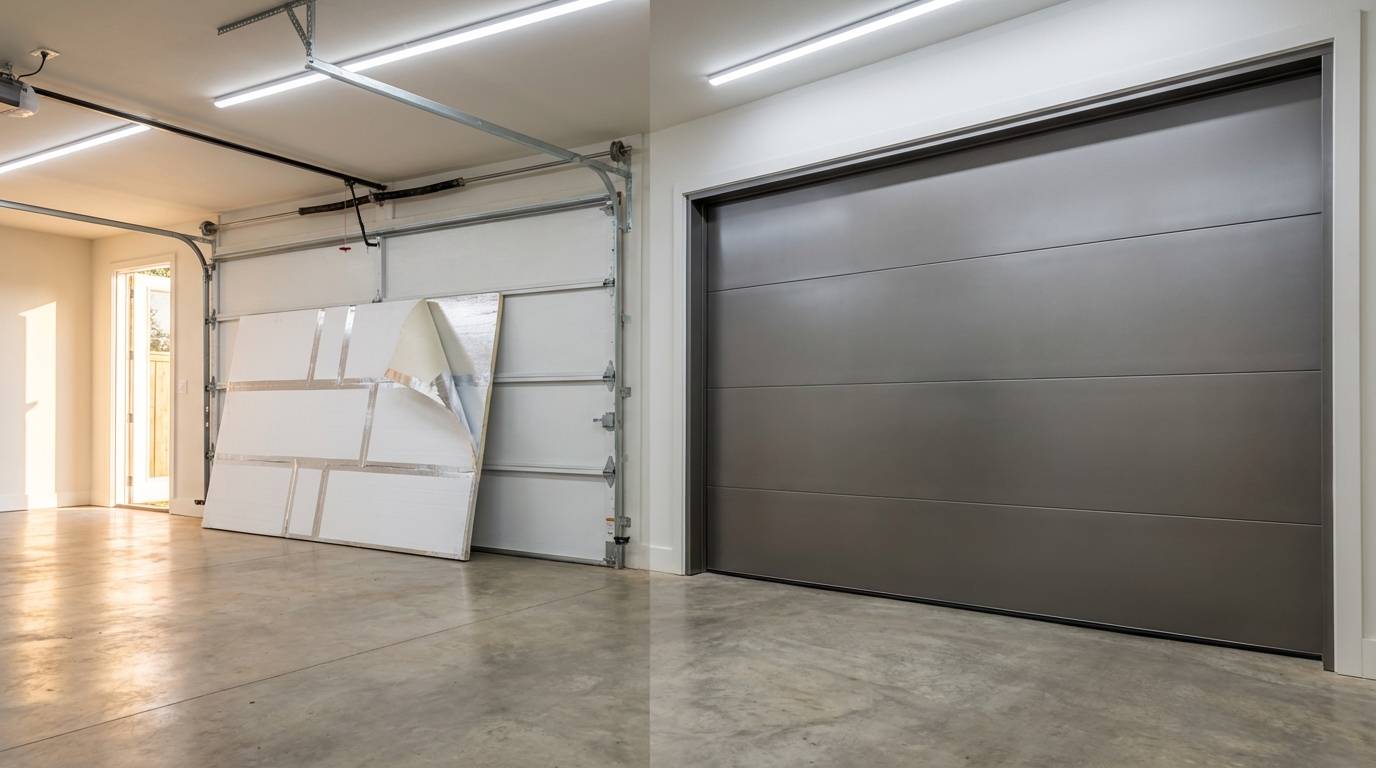
Houston's relentless summer heat turns uninsulated garages into blazing ovens, often pushing interior temperatures well past 100 degrees. While upgrading your garage door's thermal boundary is non-negotiable for energy efficiency and comfort, homeowners are immediately faced with a critical choice: spending a couple of hundred dollars on a DIY polystyrene insulation kit or investing several thousand in a factory-injected polyurethane garage door. The difference between these two options goes far beyond the initial price tag, directly impacting your home's HVAC efficiency, the lifespan of your door's hardware, and your property's overall structural integrity.
Understanding the Core Technologies: Polystyrene vs. Polyurethane
Before diving into the financial breakdown, it is essential to understand the materials at play and how thermal resistance—measured as R-value—functions in a Texas climate. R-value calculates how effectively a specific material resists the conductive flow of heat. In northern climates, homeowners focus on keeping winter heat trapped inside. In Houston, the goal is completely inverted: you must stop the oppressive radiant heat of the summer sun from penetrating the steel panels of your garage door.
Polystyrene is essentially the same rigid foam material used in disposable coffee cups and budget coolers. In the context of garage doors, it comes in large, pre-cut panels—often referred to as Expanded Polystyrene (EPS). These panels are designed to be manually trimmed and wedged into the exposed channels of a traditional single-layer steel garage door. Polyurethane, on the other hand, is a dense, liquid foam that is injected directly between two layers of steel during the manufacturing process. As it expands, it fills every microscopic crevice and chemically bonds to the metal, creating a solid, highly dense composite panel.
The DIY Polystyrene Approach
For the budget-conscious Houston homeowner, DIY polystyrene kits like the Matador Garage Door Insulation Kit or the Owens Corning Garage Door Fiberglass Insulation Kit represent an accessible weekend project. These kits typically cost between $100 and $200 for a standard two-car garage.
- The Benefits: The primary advantage is the low barrier to entry. With basic tools like a utility knife and a tape measure, you can install these panels in a few hours. They do provide a noticeable reduction in radiant heat transfer compared to bare, conductive metal, and they muffle the rattling sounds of a standard steel door.
- The Drawbacks: DIY polystyrene panels generally offer an R-value ranging from R-4 to R-8. Because these panels are simply wedged into place, they inevitably leave air gaps. In Houston's incredibly humid climate, warm exterior air can bypass the foam edges, leading to condensation against the interior steel and potentially accelerating rust. Furthermore, these panels add unexpected weight to your door. A standard two-car garage door might gain 15 to 20 pounds of foam. If your torsion springs are not calibrated for this extra weight, your garage door opener will strain, leading to premature motor failure or violently snapped springs.
The Factory Polyurethane Investment
Upgrading to a factory-insulated polyurethane garage door requires a complete replacement of your existing door system. This is a significant home improvement investment, typically ranging from $1,500 to over $3,500 depending on the door's size, architectural design, and specific thermal rating.
- The Benefits: Polyurethane doors offer superior thermal resistance, routinely achieving R-values between R-12 and R-20. Because the foam is injected as a liquid that expands to fill the entire internal cavity, there are absolutely no air gaps. This creates a true thermal break, preventing Houston's extreme exterior heat from bleeding into the garage space. Additionally, the chemical bonding process between the polyurethane and the steel layers exponentially increases the door's structural rigidity. These doors are highly resistant to dents from stray basketballs or driveway accidents. They also operate with a whisper-quiet smoothness that retrofitted DIY kits simply cannot replicate.
- The Drawbacks: The only significant drawback is the upfront cost. It requires professional installation and a commitment to replacing the entire door mechanism, including heavy-duty tracks and precisely calibrated torsion springs designed to handle the specific weight of the premium composite door.
The Houston Cost-Benefit Analysis
To determine which option yields the highest return on investment, Houston homeowners must look well beyond the retail checkout counter. If your garage is strictly used for parking vehicles and storing rugged lawn equipment, and it is completely sealed off from your home's central HVAC system, a $150 DIY polystyrene kit might provide just enough heat reduction to make the space tolerable. However, you must factor in the hidden mechanical costs. If adding polystyrene panels throws off your door's delicate balance, you will likely spend between $200 and $400 on professional spring replacement and re-balancing just to prevent destroying your automatic opener.
Conversely, if you use your garage as a home gym, a woodworking shop, or a conditioned living space, a factory polyurethane door is the only financially sound choice over the long term. A well-insulated garage acts as a massive thermal buffer for the rest of your house. By maintaining a cooler garage environment, your home's primary HVAC system does not have to work nearly as hard to cool the interior rooms adjacent to or directly above the garage. Over a ten-year lifespan, the energy savings on your peak summer electricity bills can significantly offset the premium upfront cost of a high-efficiency polyurethane door.
Durability and Property Value Implications
Houston's coastal weather patterns are notorious for rapid fluctuations, intense UV exposure, and occasional severe high-wind storms. A standard single-layer steel door retrofitted with DIY foam remains susceptible to high-wind flexing and structural denting. Factory polyurethane doors, effectively serving as solid walls of steel-reinforced foam, withstand harsh weather conditions far better. When it comes time to sell your home, a high-quality, quiet, climate-controlled garage door offers a documented return on investment, immediately enhancing curb appeal and signaling to prospective buyers that the home has been meticulously maintained.
The Final Verdict
While DIY polystyrene kits offer a cheap, temporary band-aid for an overheating garage, they fall critically short of providing comprehensive climate control and almost always introduce mechanical strain on your existing hardware. Factory polyurethane doors require a larger initial investment but deliver unmatched energy efficiency, rugged durability, and operational silence. For homeowners serious about protecting their vehicles, lowering their energy bills, and maximizing the utility of their garage space in the relentless Texas heat, factory-injected polyurethane is the undisputed winner.
If you are ready to transform your garage from a sweltering storage space into a comfortable, energy-efficient extension of your home, expert guidance is just a phone call away. Contact Mobil Garage Door today to schedule a comprehensive consultation and explore our premium line of heavy-duty, polyurethane-insulated garage doors tailored specifically for the extreme Houston climate.